
Kanban vs Scrum sets the stage for this enthralling narrative, offering readers a glimpse into a story that is rich in detail with casual formal language style and brimming with originality from the outset.
In the realm of project management, Kanban and Scrum stand out as two popular Agile methodologies that have garnered significant attention. Understanding the core principles, key differences, and practical applications of these approaches is essential for project success. Let’s dive into the world of Kanban vs Scrum and unravel the intricacies that define them.
Kanban vs Scrum Overview

In the realm of project management methodologies, Kanban and Scrum are two popular frameworks that help teams work more efficiently. Each has its own set of core principles and practices that guide how work is organized and completed.
Core Principles of Kanban and Scrum
- Kanban focuses on visualizing work through a Kanban board, limiting work in progress, and continuous delivery of tasks.
- Scrum, on the other hand, emphasizes fixed-length iterations called sprints, daily stand-up meetings, and defined roles like Scrum Master and Product Owner.
Key Differences Between Kanban and Scrum
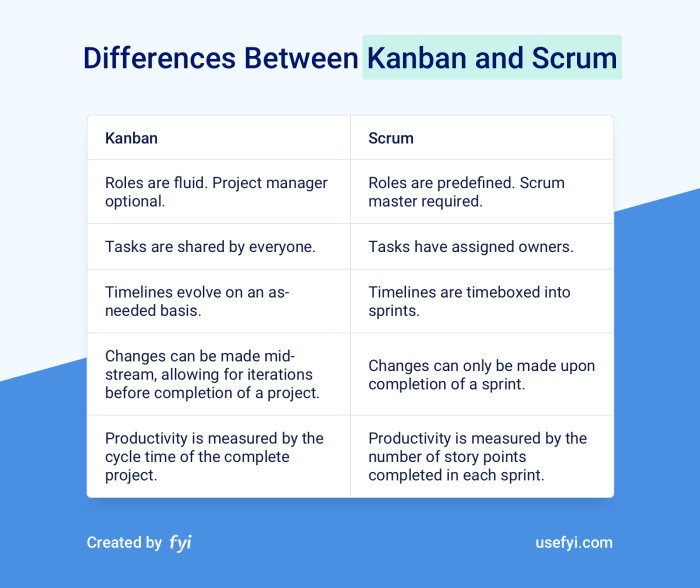
- Kanban is more flexible and allows for continuous flow of work, while Scrum has a more structured approach with defined roles and time-boxed iterations.
- Kanban does not prescribe specific roles or ceremonies, while Scrum has well-defined roles, meetings, and artifacts like the Product Backlog and Sprint Backlog.
Origins and Evolution of Kanban and Scrum
Kanban originated in manufacturing at Toyota as a system to improve efficiency and reduce waste. It was later adopted in software development and project management for its simplicity and focus on flow.
Scrum, on the other hand, traces its roots back to a paper by two Japanese authors in the 1980s and has since evolved into a widely-used Agile framework for iterative and incremental development.
Kanban Methodology
Kanban is a visual project management method that helps teams efficiently manage their workflow by visualizing work, limiting work in progress, and maximizing efficiency.
Kanban Board Structure and Significance
A Kanban board is a visual representation of the workflow, typically divided into columns representing different stages of work. Each task or work item is represented by a card that moves through the columns as it progresses. The main significance of the Kanban board is that it provides transparency, accountability, and helps in identifying bottlenecks in the process.
- The “To Do” column: This column represents tasks that are waiting to be started.
- The “In Progress” column: This column contains tasks that are currently being worked on.
- The “Done” column: Tasks that have been completed are moved to this column.
Visualizing the workflow on a Kanban board helps teams prioritize tasks, identify blockers, and maintain a steady flow of work.
Industries where Kanban Methodology is Commonly Used
Kanban methodology is commonly used in industries such as software development, manufacturing, healthcare, and marketing. It is particularly effective in environments where work is constantly evolving and priorities shift frequently.
- Software Development: Kanban is widely used in software development for managing feature development, bug fixes, and maintenance tasks.
- Manufacturing: In manufacturing, Kanban is used to manage inventory levels, production schedules, and material flow.
- Healthcare: Hospitals and healthcare facilities use Kanban to optimize patient flow, manage resources, and improve efficiency in patient care.
- Marketing: Marketing teams utilize Kanban to plan and execute campaigns, track deadlines, and collaborate effectively.
Scrum Framework
Scrum is a popular Agile framework that emphasizes collaboration, iterative development, and continuous improvement. In Scrum, teams work in sprints to deliver increments of a product, following a set of roles, events, and artifacts.
Roles and Responsibilities in Scrum Teams
In a Scrum team, there are three main roles:
Product Owner
Represents the stakeholders and ensures the team is working on the right priorities.
Scrum Master
Facilitates the Scrum process, removes impediments, and helps the team follow Scrum practices.
Development Team
Self-organizing group of professionals responsible for delivering the product increment.
Scrum Events
Scrum events are time-boxed and provide structure to the framework. The main events in Scrum are:
Sprint
A time-boxed iteration where the team works to deliver a potentially shippable product increment.
Daily Standup
A short daily meeting where team members discuss what they did yesterday, what they plan to do today, and any impediments.
Sprint Review
A meeting at the end of the sprint where the team demonstrates the product increment and gathers feedback.
Sprint Retrospective
A meeting at the end of the sprint where the team reflects on their process and identifies areas for improvement.
Importance of Continuous Improvement in the Scrum Framework
Continuous improvement is a key principle in Scrum that allows teams to adapt and enhance their processes over time. By regularly reflecting on their work and identifying areas for improvement in sprint retrospectives, Scrum teams can increase their efficiency, productivity, and product quality. This focus on continuous improvement helps teams deliver more value to their customers and stakeholders.
Kanban vs Scrum Comparison
In comparing Kanban with Scrum, it is essential to understand the distinct characteristics of each approach and how they can impact project management. Kanban offers a more flexible and adaptive framework, while Scrum provides a structured and iterative methodology. Let’s delve deeper into the advantages and disadvantages of each approach and discuss scenarios where one might be more suitable than the other.
Flexibility of Kanban vs Structure of Scrum
- Kanban allows for continuous delivery and changes in priorities, making it ideal for projects with unpredictable requirements or frequent changes.
- Scrum, on the other hand, follows a fixed sprint cycle with defined roles and ceremonies, providing a structured approach to project management.
- While Kanban focuses on visualizing work and limiting work in progress, Scrum emphasizes time-boxed iterations and regular feedback.
Advantages and Disadvantages
- Kanban:
- Advantages:
- Flexibility to adapt to changing requirements.
- Efficient for continuous delivery and flow-based work.
- Disadvantages:
- Less structured approach may lead to lack of predictability.
- Difficulty in setting clear deadlines and commitments.
- Advantages:
- Scrum:
- Advantages:
- Structured framework with defined roles and responsibilities.
- Promotes collaboration and regular feedback through sprint reviews.
- Disadvantages:
- Rigid sprint cycles may not accommodate changing priorities effectively.
- Requires adherence to specific Scrum ceremonies and roles.
- Advantages:
Scenarios for Choosing Kanban or Scrum
- In a dynamic environment where requirements frequently change, Kanban may be more suitable due to its flexibility in adapting to evolving needs.
- For projects with well-defined goals and stable requirements, Scrum’s structured approach and fixed iterations can provide better predictability and control.
- Teams looking to optimize workflow efficiency and visualize work progress may benefit from implementing Kanban, while those seeking a more disciplined and collaborative approach may opt for Scrum.
Project Management
Project management plays a crucial role in the successful implementation of Kanban and Scrum methodologies. Both Kanban and Scrum offer unique approaches to project management, allowing teams to organize tasks, track progress, and deliver results efficiently.
Incorporation of Kanban and Scrum in Project Management
- Kanban: Kanban focuses on visualizing workflow and limiting work in progress. Project managers can use Kanban boards to track tasks in real-time, identify bottlenecks, and ensure smooth workflow.
- Scrum: Scrum emphasizes iterative development and regular feedback. Project managers can utilize Scrum ceremonies like Daily Standups, Sprint Planning, Sprint Review, and Retrospectives to keep the team aligned and drive continuous improvement.
Examples of Successful Project Management
- Kanban: A software development team implemented Kanban to manage feature requests and bug fixes. By visualizing the workflow on a Kanban board, they improved communication, reduced lead times, and delivered higher quality products.
- Scrum: A marketing team adopted Scrum to launch a new campaign. Through short, focused sprints and regular feedback loops, they increased collaboration, met deadlines, and achieved campaign objectives effectively.
Choosing Between Kanban and Scrum
- Project managers can choose between Kanban and Scrum based on project requirements.
- Kanban: Ideal for projects with a continuous flow of work, where flexibility and visual management are key.
- Scrum: Suitable for projects with defined goals, fixed timelines, and a need for regular adaptation and feedback.
- Consider the project scope, team dynamics, and stakeholder preferences when selecting the most appropriate methodology.
In conclusion, the comparison between Kanban and Scrum reveals the unique strengths and weaknesses of each methodology, offering project managers valuable insights into selecting the most suitable approach for their projects. By exploring the origins, frameworks, and real-world examples of Kanban and Scrum, professionals can enhance their project management practices and drive success in their endeavors.
FAQ Summary
Which industries benefit most from Kanban methodology?
Answer: Industries with continuous workflows and a focus on visualizing work processes, such as software development, manufacturing, and marketing, benefit greatly from Kanban methodology.
How does Scrum encourage continuous improvement?
Answer: Scrum promotes continuous improvement through regular Sprint Reviews and Retrospectives, where teams reflect on their work, identify areas for enhancement, and implement changes in subsequent iterations.
When should a project manager choose Kanban over Scrum?
Answer: Project managers should opt for Kanban when the project requires more flexibility in task prioritization, a focus on minimizing work in progress, and a continuous flow of work without fixed time constraints.


